

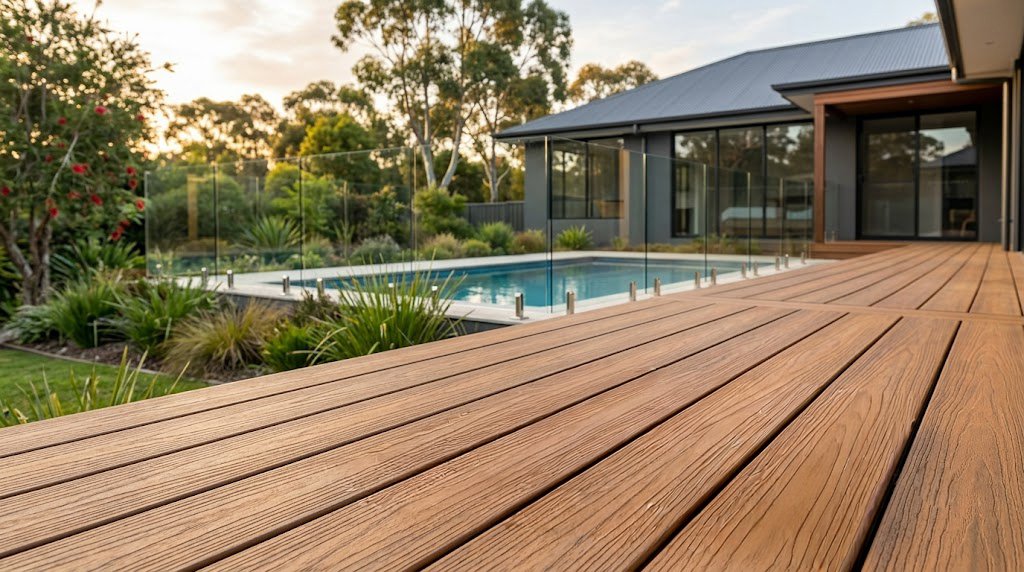
Composite decking has quietly replaced hardwood on a lot of Sydney decks, and for good reason: no oiling every summer, no splinters, and a colour that stays close to the day it was installed. The first decision most people face is whether to use hollow or solid boards. Both are made from the same wood-plastic composite; the difference is what is going on inside the profile.
Hollow composite decking
Hollow boards run chambers through the middle of the profile, which makes them lighter to handle and quicker to lay over a prepared frame. Our hollow boards are 140 × 22 × 5400 mm and dual-sided, so you can choose which face to show — one side usually has a finer grain than the other.
They come in eight colours: Grey, Lavender Blue, Maple, Coffee, Ebony, Teak, Redwood and Antique. Matching fascia and edge boards (138 × 23 mm) finish the perimeter so you never see the chambers.
Hollow boards suit balconies, courtyards, pool surrounds and anywhere weight matters — a lighter deck puts less load on an existing structure.
Solid composite decking
Solid boards have no internal chambers. They are heavier, denser underfoot, and more forgiving of point loads such as a heavy planter or a pedestal leg. Ours measure 140 × 23 × 5400 mm and come in six colours: Mahogany, Oldwood, Natural Oak, Smokey Grey, Walnut and Teak.
The important difference for many Sydney properties is that our solid decking is BAL 19 rated for use in designated bushfire-prone areas. If your council has set a Bushfire Attack Level for the site, that rating decides the conversation before colour does.
What both share
Neither needs sealing, staining or painting. Both resist water, termites, rot and mould, both are UV and fade resistant, and both are built to cope with temperatures from -40°C to 70°C — which covers a western Sydney summer comfortably.
Choosing between them
If the property is in a bushfire-prone area, start with solid. If you are decking a balcony, a rooftop or anywhere that weight is a consideration, hollow is usually the sensible answer. For a standard backyard deck, either works, so the decision often comes down to the colour you want and how the board feels when you stand on a sample.
Browse the full range of composite decking, or request a quote with your measurements and we will work out board counts, edge boards and fasteners for you.